Life Skills Infographic Template Bundle: Graphics Review
First Impressions: Structured Clarity for Educational Branding
When evaluating a new graphic design asset for a client project, my primary concern is always versatility versus specificity. Recently, while developing a comprehensive visual identity and content strategy for an educational coaching brand, I tested the Life Skills Infographic Template Bundle. The immediate impression was one of organized professionalism. Unlike decorative clipart that serves only as filler, this collection presents itself as a functional framework for communication. The mood is constructive and approachable, striking a balance between academic rigor and modern accessibility.
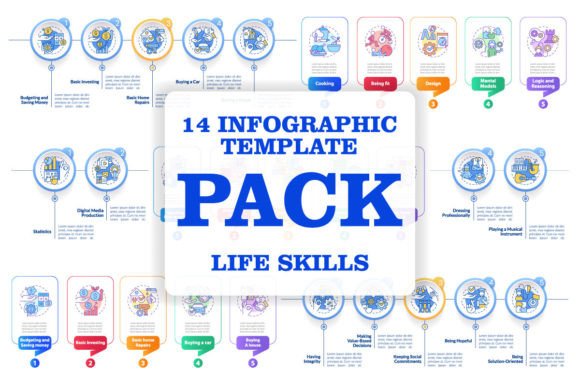
For designers working with coaches, educators, or corporate trainers, this bundle offers a distinct advantage. It avoids the chaotic energy often found in generic illustration packs. Instead, the workflow layout with line icons provides a clean aesthetic that supports, rather than competes with, dense textual information. In my initial assessment, the assets felt tailored for clients who need to translate abstract concepts—like personal development or vocational training—into digestible marketing visuals. The style leans towards contemporary minimalism, making it highly compatible with small business branding that values clarity over ornamentation.
Translating Abstract Abilities into Visual Data
The core challenge in my recent client project was visualizing "soft skills" and "talents" without resorting to clichéd stock photography. This is where the Life Skills Infographic Template Bundle proved its worth as a serious digital product. The included editable timeline info chart allowed me to map out skill acquisition progressions logically. Rather than forcing a square peg into a round hole, the templates provided pre-structured containers for data visualization that maintained visual hierarchy even when populated with complex client copy.
In practical application, these templates functioned as more than just pretty pictures; they were problem-solving tools. When designing a series of LinkedIn carousel posts and accompanying blog headers, the data visualization with steps elements helped break down long-form articles into engaging snippets. For a handmade business or digital seller creating course materials, this level of structural integrity is rare. The line icons are sufficiently detailed to be recognizable at smaller sizes but simple enough to scale up for presentation decks without pixelation or visual noise. This adaptability is crucial for maintaining brand consistency across diverse touchpoints.
Performance Across Digital and Print Mediums
A true test of any design bundle is how well it translates across different formats. During the project, I utilized these assets for both screen-based social media graphics and physical printable design collateral. The vector-based nature of the files meant that resizing for an Instagram Story versus an A4 workshop handout required zero compromise on quality. For Cricut project enthusiasts or print-on-demand sellers, the clean lines are ideal for vinyl cutting or sublimation, provided the user understands layer management.
I found the templates particularly effective for editorial design and web design hero sections. They add texture and interest to otherwise text-heavy pages without increasing cognitive load. However, for packaging design or product labels, selectivity is key. While the icons work beautifully as secondary supporting elements on a box or tote bag, they should not dominate the primary brand mark. The bundle shines brightest when used to explain processes, such as on the back of a service brochure or within a digital download PDF guide sold on an Etsy product listing.
Navigating Limitations and Contextual Fit
No creative design asset is universally perfect, and professional judgment requires knowing when not to use a tool. The Life Skills Infographic Template Bundle excels in structured environments but can feel out of place in highly organic or luxury contexts. If your client’s brand identity relies on fluid, hand-painted watercolors or high-contrast brutalist typography, these structured line icons may create visual dissonance. They are inherently rational and orderly; they do not convey raw emotion or artisanal imperfection.
Furthermore, caution is advised when using these templates at very small scales, such as favicon-sized web elements or intricate sticker design. The line weight, while elegant, can disappear against busy backgrounds or when printed on low-resolution office printers. In modern design layouts with significant negative space, they breathe beautifully. However, in crowded compositions typical of discount retail flyers or dense technical manuals, they risk getting lost. Designers must also be mindful of color contrast; because many templates rely on line work, placing them on similarly toned backgrounds without a solid fill or stroke adjustment will destroy readability and visual trust.
Technical Due Diligence for Commercial Application
Before integrating this bundle into a paid client deliverable, rigorous technical vetting is non-negotiable. As a professional, I always perform the following checks to ensure the commercial license covers the intended use and the files meet production standards:
- Contrast Testing: Always preview the PNG design files in grayscale first. If the infographic isn't legible in black and white, it will fail in accessibility compliance and single-color print runs.
- Typography Pairing: Test the templates against various font families. I found they pair exceptionally well with geometric sans-serif fonts for a tech-forward look, but can also work with humanist serifs for a warmer, educational feel. Avoid overly ornate script fonts, as they clash with the precise geometry of the illustration work.
- Vector Integrity: If using the SVG design files for sublimation design or large-format printing, open them in Illustrator or Affinity Designer to check for open paths or stray anchor points. Clean vectors are essential for professional output.
- Mockup Validation: Never present the asset in isolation. Place it on real product mockups or device screens to verify scale. What looks balanced on a 27-inch monitor may look microscopic on a mobile phone or overwhelming on a mug.
- Licensing Verification: Confirm whether the commercial design rights extend to resale. While excellent for client services and internal marketing, some bundles restrict use in products intended for direct resale as standalone digital assets.
Enhancing Professionalism Through Strategic Assets
Ultimately, the value of the Life Skills Infographic Template Bundle lies in its ability to elevate perceived expertise. For a creative marketplace seller or a freelance designer, having a library of cohesive, high-quality design assets reduces production time while increasing output quality. These templates provide a visual shorthand for competence. When a potential customer sees a well-structured Canva template or a polished webinar slide derived from this bundle, they subconsciously attribute that organization to the brand itself.
The bundle supports audience engagement by reducing friction. People process structured visuals faster than unstructured text. By utilizing these infographics to outline services, explain methodologies, or showcase talent frameworks, businesses can communicate value propositions more effectively. Whether you are crafting a logo design companion piece, a social media campaign, or a comprehensive course curriculum, this asset serves as a reliable foundation. It bridges the gap between raw information and compelling narrative, which is the hallmark of successful graphic design. Just remember to treat it as a flexible system rather than a rigid cage, adapting its components to serve the unique voice of every specific project.